Showing posts with label Pope Francis. Show all posts

Saturday, 17 January 2015

On not calling murdered children 'suicide bombers'


While the world was preoccupied with events in Paris, Boko Haram was carrying out its deadliest yet attacks in northern Nigeria, using young girls as human bombs. The western media calls these children ‘suicide bombers’. Some reports suggest that they may have been from among the schoolgirls kidnapped in April 2014.

A British judge has been widely criticised for saying that a sixteen year old girl ‘groomed’ her abusive school teacher, showing how selective we are in our moral outrage. To call those little girls suicide bombers is like calling a victim of sexual abuse a rapist, but where are the howls of protest? We seem incapable of fully acknowledging the plight of those in the Muslim world whose persecution and suffering does not directly affect us.

Muslim victims of radical extremism and western militarism alike seldom capture the attention of the media in the way that non-Muslim victims do, even though a Muslim is much more likely to be killed by a radical Islamist or an American or British drone or bomb than a non-Muslim westerner is to be killed by a Muslim. The vast majority of Muslims are either innocent bystanders or victims of this present conflict between Islamic State and the modern secular state. They are less accountable for what is being done in the name of their religion, than the citizens of Britain and America are for what has been done in our name in the wars in Iraq and Afghanistan and in the continuing use of drones to carry out illegal executions of those identified, rightly or wrongly, as potential terrorists. It is our taxes which pay for these wars and attacks, and it is our 'democratic' laws which encourage heavy corporate investment in an arms industry which feeds on such conflicts. Whatever our religion or nationality, we are all caught up in events far outside our control, which leave many of us feeling both impotent and guilty by association.

Early in January, Canon Alistair Macdonald-Radcliff wrote in a blog in the Catholic weekly, the Tablet, that ‘modern Islam seems to have difficulty in establishing that extremist interpretations are wrong in ways that command universal recognition’, and he suggests that extremism ‘tarnishes’ even peace-loving Muslims who fail to condemn it. A cartoon currently circulating on Facebook shows hooded members of the Ku Klux Klan alongside flag-waving members of Islamic State (ISIS), with the caption, ‘Nobody thinks these people are representative of Christians, so why do so many people think that these people are representative of Muslims?’


To expect any peaceful majority to gain ‘universal recognition’ is to fail to appreciate the pervasive power of violence to silence voices of moderation. Millions of us took to the streets in February 2003 to protest the war in Iraq, yet go to war we did, and the rest is not yet history. If our democratically elected leaders can unleash such slaughter in our name, how can we ask ordinary Muslims to take responsibility for the actions of those they never voted for or supported, simply because they appropriate the name of Islam for their cause?

That is the context in which we must speak of the Charlie Hebdo cartoons, even as we unequivocally condemn the murders of the cartoonists. If those cartoonists had been satirising ISIS, the Taliban or Al Qaeda, they might have found widespread support among Muslims who shared their revulsion. But the Muhammad cartoons violated Islam’s most revered and beloved figure, more authentically revered by those law-abiding Muslims who devoutly practise their faith than by those who use Islam as a front for murder. Charlie Hebdo’s crude images lack the slightest subtlety that would make them worthy of the name ‘satire’. They were acts of crass and shameless provocation which demanded of every French Muslim citizen more tolerance than any civilized society should ask in the name of freedom of speech. As Pope Francis has reminded us, ‘every religion has its dignity’ and there are limits to freedom of expression. The cartoons are an assault on the dignity of Islam and its followers, and there is never any justification for attacking human dignity.

I do not ask my Muslim neighbour to apologise or explain, for she and I both agree that what is done in our name is not what we would choose. Let’s avoid the sloganeering of a faux innocence, and face the truth in all its savage complexity and fragile hope. And when children are murdered, let’s call each child by name and name what has been done to her in the name of some cause she will never know or understand. To call a murdered child a suicide bomber is to violate her all over again.

 https://blogger.googleusercontent.com/img/b/R29vZ2xl/AVvXsEjAKWm37MraPpnW98y8LvmAvnoA_lemZ5mTDZphtl_C_D4wBauTwehDhgDhSWOSq4KN-zo5cD1T9VfiFvM1DbQMEe1yU-kcGE1ENC7FkZjdbXXSGWLjJLXm66N-PR8qKA1JN3nBVhyphenhyphenM1mHp/s1600/missing+nigerian+girls.png

Tuesday, 11 November 2014

Along the Pilgrim Path - The Synod on the Family and Pope Francis's Theology

This is the final draft of my article on the Synod on the Family and Pope Francis's theology which was published in The Tablet on1 November, 2014 with the title 'Towards Faith, Hope and Love':


I was in Rome during the Synod on the Family. On the final Saturday morning I visited the ancient church of Santa Maria in Trastevere during a Nuptial Mass. As the couple knelt below the dome with its shimmering mosaic of the Coronation of the Virgin, I thought how beautifully that image evoked the sacrament of marriage, which constitutes the earthly participation of baptized Catholics in the heavenly wedding feast.

Metaphors of marriage and parenthood recur throughout scripture. These relationships offer us our most intimate glimpses of the unconditional love of God for creation and of Christ for the Church, but they are also the relationships that are most vulnerable to sin and alienation.

At the Synod, the Church’s leaders spoke openly, not only about the ideals and consolations of marriage but about its failures and tragedies, its struggles and complexities, putting the vast and unruly diversity of global Catholicism on display before the eyes of the world. The western media tended to focus almost exclusively on homosexuality and divorce and remarriage, but the Synod also addressed issues such as polygamy, forced marriages and child marriages, mixed marriages, and the impact of poverty, violence and migration on family life.

There were some gaping omissions, not least in the absence of any significant female presence. Pope Francis has repeatedly acknowledged the need to give women a greater role in the Church, and in this respect the Synod was a missed opportunity. We heard nothing about HIV/AIDS, nor does there seem to have been any searching debate about contraception, despite evidence that the vast majority of Catholics ignore the Church’s prohibition of artificial birth control. Nevertheless, my concern here is not to analyse the Synod’s successes and failures, but to ask what kind of theology informs Pope Francis’s vision for the Church so that he was inspired to call not one but two successive Synods on the Family.

Francis repeatedly used the metaphor of a journey during the Synod. In a prayer vigil before it started, he offered a moving description of people travelling home at the end of the day – some to the comfort and warmth of a family meal, others to loneliness and broken dreams. In his closing speech he spoke of having been on a journey that involved moments of great enthusiasm and also of desolation.

Critics of Pope Francis sometimes compare him unfavourably with his more scholarly predecessor, Pope Benedict XVI. Yet I believe that we are witnessing a papacy rooted in profound theological wisdom, informed by three related principles: Ignatian discernment which comes from Francis’s Jesuit roots, a privileging of narrative and story-telling (a theology of the people) over dogmatics and systematics (a theology of the scholars), which comes from his Argentinian background, and an appreciation of the temporal and historical nature of the Church’s earthly pilgrimage, which can be seen as continuing the interrupted process of implementing Vatican II in the life of the Church.

In a section towards the end of his apostolic exhortation, Evangelii Gaudium, Francis appeals for an ethos of transformation and growth that privileges time over space. A spatial model is one of occupation and crystallization, of immediate results and short term goals. It seeks to achieve everything in the here and now, by way of power and possession. A temporal model allows for ‘processes of people building’ by embracing the tension between fullness and limitation. It accommodates frustration, finitude and failure without losing sight of its horizon of hope. This leads to two other factors – the dialectical need to accept that conflict is a necessary aspect of the quest for ‘a diversified and life-giving unity’, and the need to recognise that realities are more important than ideas.

These three related insights offer a key to understanding not only the Synod but the whole style of Francis’s papacy. He is setting the Church free from her captivity to doctrinal stasis, from a unity imposed through the suppression and silencing of conflict and the privileging of ideas over realities, so that she can continue her earthly, temporal pilgrimage informed by the struggles and experiences of life in motion.

Dogmas and teachings that were frozen in the context of spatial absolutes as eternal, unchanging truths are gradually thawing, warmed by the bodies and breath of human experience and allowed to flow with the currents of time. It remains to be seen what will emerge from this process, but that is the point. We do not and cannot control the future. The Second Vatican Council pointed to the contextual and the historical as the road along which the pilgrim people of God must travel, and Pope Francis has told us we must resume the journey. Our guiding light and final destination is the mystery of the Trinity, the ultimate object of all our desire. The Holy Spirit animates and guides us towards what Francis has described as the untamed frontiers of faith, but in travelling towards that mystical destination we must put on our walking boots, learn the virtue of patience, and struggle to read the maps together.

This is the context in which we should interpret the principle of gradualness referred to in the interim document, the Relatio post disceptationem, published after the first week. Some have equated gradualism with relativism, but perhaps that is because they are working with a spatial rather than a temporal model. Relativism suggests that there are many paths to follow which are all simultaneously valid and equal, which clearly is not compatible with the self-understanding of the Church’s mission. However, a temporal model would allow us to interpret gradualism in terms of personal growth and development in the context of each individual’s journey along the pathway of truth.

So back to that Nuptial Mass. Into the vast space between the couple kneeling on the altar and the mosaic far above their heads, the priest raises the host. My heart is filled with a longing so delicate and impossible that there are no words for it. We know that the couple may or may not stay faithfully together until death. Even if they do, they will face many challenges, struggles and failures. Yet the desire that their love arouses swirls in the space between the hope that unites the newly weds, and the promise of fulfilment that shimmers down from the golden mosaic high above them.

At last, the Church is asking what that desire and love might mean in the face of many different lives and loves, many cultures and contexts, many obstacles and failures. Our desire is for union with the relational, Trinitarian God in whose image we are made. That desire finds inadequate expression in the relationships that touch our humanity most deeply – relationships of erotic love and sexuality, of marriage and commitment, of motherhood and fatherhood. But all these are imperfect analogies through which we obscurely glimpse that eternity of love towards which we are travelling, at the heavenly wedding feast where God will wipe away every tear, and there will be no more death or mourning or crying or pain. Until then, Francis is appealing to the Church to accompany the human family along the rocky path of mourning and tears, which is also the pilgrim path of faith, hope and love.

Monday, 20 October 2014

After the Synod - a journey into the unknown


The Synod on the Family - journeying into the unknown
And it has been “a journey” – and like every journey there were moments of running fast, as if wanting to conquer time and reach the goal as soon as possible; other moments of fatigue, as if wanting to say “enough”; other moments of enthusiasm and ardour. There were moments of profound consolation listening to the testimony of true pastors, who wisely carry in their hearts the joys and the tears of their faithful people. Moments of consolation and grace and comfort hearing the testimonies of the families who have participated in the Synod and have shared with us the beauty and the joy of their married life. A journey where the stronger feel compelled to help the less strong, where the more experienced are led to serve others, even through confrontations. And since it is a journey of human beings, with the consolations there were also moments of desolation, of tensions and temptations ... (Pope Francis, Speech at the Conclusion of the Synod)
In Evangelii Gaudium, Pope Francis contrasts the politics of time with the politics of space. The politics of space is utopian, driven by a sense of urgency, seeking to achieve instantaneous fulfilment and therefore always short-term, frozen in time and vulnerable to abuses of power. The politics of time allows for transformation through growth, for change as a process, for acceptance of limitation and finitude, for the seeding of ideas and their gradual nourishment in people's hearts and minds, and in our institutions.

The Synod is a beautiful example of this wisdom at work, with its unfolding of a vision conceived in intense struggle, conflict, disagreement and commitment, that now has a year to germinate and begin to grow. The seeds of change have been sown. Now the whole community of God's prolific, diverse and unruly family must create the fertile soil in which these seeds might eventually bear fruit. That is the soil of prayer and reflection, of lectio divina - prayerful meditation on what the scriptures are saying to us. It is also the soil of open and honest dialogue, among people responsive to Pope Francis's call to travel audaciously to the wild frontiers of faith, and to resist the temptation to domesticate those frontiers and turn them into a laboratory for the analysis of abstract truths.

The Synod document has been published in Italian, with an English translation expected soon. Pope Francis's final speech to the Synod received a standing ovation. Many are expressing disappointment that, in the end, the tentative and pastorally sensitive paragraphs on divorce and remarriage, on those in 'irregular relationships', and on welcoming persons with a homosexual orientation that found space in the interim document were not included in the final version of the Relatio Synodi. However, in the remarkable spirit of openness that has characterised this whole Synod, the excluded paragraphs have still been published. It is worth nothing that, while they did not achieve the two thirds majority which would have allowed them to be included in the official document, they nevertheless received a significant majority of votes. (The paragraph on homosexuality failed to be included by only two votes). You can read them here with a tally of the votes. There is a delicious paradox at work in all this, because if one publishes the excluded paragraphs in a working document, in what meaningful sense can one possibly say they have been excluded? Everything is up for discussion. Nothing is set in stone. Nothing has, in fact, been excluded.

Until the election of Pope Francis, it would have been almost impossible to imagine an event like this happening in the Church in our time. The sclerosis of authoritarianism, the censoriousness of the CDF, the sense of scandal, corruption, cowardice and defensiveness infecting the hierarchy, these were all signs of a Church suffering from a profound sickness of the soul that would surely take generations to heal, if it were not - as some would argue - a church in terminal decline. When Francis was elected, many of us were as incredulous as we were elated, and that incredulity quickly gave rise to scepticism. He is a master rhetorician, a consummate story teller who intuitively understands the power of symbols and gestures to transform beautiful words into deeply moving and meaningful acts of solidarity, compassion and humour. But is there any more to him than that? Is it all style and no substance?

And now, Francis has opened the flood gates. All that was silenced, forbidden and hidden in the name of a burdensome and oppressive conformity can and must be said. The Church faces a year in which each and every one of us must take the opportunity we are being offered. This means entering into dialogue, tearing up the labels, disregarding hierarchical privileges and punishments, and becoming a community of disciples who are willing to go barefoot into the wilderness in order to struggle together to water the seeds of hope and nurture the tender shoots of new beginnings.

Of course there are disappointments. The LGBTQ community has been quick to express its regret about the final document's exclusion of the language of welcome and inclusion. For divorced and remarried Catholics, this will be an anxious year of waiting to see what decisions will be made at the Synod in 2015, regarding the possibility of a process of sacramental reconciliation with the Church. For those in so-called 'irregular relationships' - probably the vast majority of the world's Catholics, if we include not just cohabiting couples, the divorced and remarried and lesbian and gay Catholics, but also those in mixed marriages or in forced marriages, those in polygamous marriages, those many priests with secret lovers and families - the situation remains deeply unresolved. It will take a great deal of patience and courage to address such issues and ask what they mean for the Church's understanding of 'family'.

Challenging though these issues are, the monumental failure of this Synod has been the absence of women capable of representing the vast plurality and diversity of women's lives and struggles in the context of the family. Where are those who would speak for some 800 of the world's poorest women who die every day for want of obstetric care, including those dying from botched abortions? Where are those who would speak for the grandmothers of Africa, raising children orphaned by AIDS? Where are those who would speak for the mothers of the Philippines, leaving their children in the care of others so that they can go and care for the children of the wealthy in a strange land? Where are those who would speak for girls deprived of education and freedom by religious and political regimes which have yet to recognise them as fully human? Where are those who would have turned their attention on that absurd gathering of celibate men and demanded a greater voice for women at all levels of the Church's life?

Women have spoken only as wives and mothers, as one half of a couple carefully selected for its conformity to the Church's vision of 'the family'. This is not to deny that a number of them raised issues concerning those who might be in 'irregular relationships' or who might have gay children, but even so, these couples were speaking as and for the normative and narrow model of what it means to be a Catholic family. That makes it vital that many others speak out during this coming year - single people, including single parents; elderly people, including the bereaved or abandoned; the divorced and remarried; childless couples - I could go on and on. But what about those who have no voice, including the very old and the very young? What about those dying in solitude for want of love, in lonely and neglected homes or in prisons and ghettoes where solitude is an impossible luxury? What of those for whom 'family' is an unending daily grind of hunger, homelessness, violence and despair? What of those for whom 'family' is an impossible dream of wholeness woven against a shattered background of broken promises and hopes betrayed? Often, it is women and girls - as mothers, grandmothers, sisters, aunts, siblings - who are in the front line of these situations as both victims and carers. They are the experts, the voices of authority. These are the voices that must be heard during the coming year.

Another vital and related challenge is that of bridging the gulf between the West and the rest, and this will require recognising that the Church truly is a living body that flourishes through unity in diversity. But what is the cost of unity, and how much diversity can be accommodated? That is a challenge to all sides.

By the end of the Synod, it was clear that the African bishops in particular had staked their claim to a say in the Church's teachings, and it was in no small part due to their influence that issues of homosexuality were sidelined. Africa is now home to 130 million of the world's Catholics, and the African Church is a vibrant and flourishing source of material as well as spiritual support to some of the poorest and most marginalised people on earth. It is also home to a burgeoning middle class and to an educated intellectual elite. It is impossible to speak in general terms about 'Africa', for it is a continent that is geographically, culturally, linguistically and religiously more diverse and multi-facetted than Europe. It is true that the fault lines which run through the Church around issues of sexual ethics are by and large those which divide western liberals from Catholics of the global South, but we should not forget that that means that women and oppressed minorities, including gays and lesbians and those belonging to minority religious and ethnic communities, can suffer even more harshly at the hands of those who embody frozen ideas of 'culture' and 'tradition', usually rooted in powerful patriarchal hierarchies.

Let me suggest that, in facing these challenges, we might follow Francis and unify all our endeavours in this mighty time of risk and opportunity around the question of inclusion and exclusion, not on grounds of sexual orientation or marriage, but on grounds of economic justice. As a feminist, I am increasingly aware of the gulf that is growing between socially-minded feminists whose first priority is justice for women who are victims of poverty, violence and various forms of displacement and alienation, and those who are more preoccupied with glass ceilings and career opportunities. If a woman smashes the glass ceiling to get to the top of the economic or political ladder and sends a lacerating shower of injustice down upon women still trapped on the ground, it achieves nothing worth having. (What did Margaret Thatcher do for women)? I think there is an analogy with campaigns for LGBTQ rights.

The LGBTQ community - and really, I think we are talking about gay men, for the voices of women tend to be muffled here too - has the distinct advantage of attracting the attention of the western media as no other group or topic can. Just look at how that issue has been covered to the exclusion of every other issue discussed during the Synod. Can those who enjoy sexual rights - fragile and contested though they often are - use that powerful voice to speak on behalf of all those whose rights are denied, and not just on behalf of their own particular community of exclusion?

If we can find consensus on issues of social and economic justice, then we can ask in what ways women and gay people are particularly affected by injustices that stem from poverty, lack of education, sexual abuse and stigmatisation. But if we focus instead on carte blanche issues of women's rights or gay rights, we risk promoting an agenda heavily biased towards a liberal western elite which, let's face it, in fifty years of gradually accumulated individual rights, including sexual rights, has done nothing to turn the tide of social and economic injustice. On the contrary. The era of individual rights in the West has been accompanied by the rise of a political system that is utterly servile to corporate interests and bereft of any vision of justice or the common good. It has produced a generation of children starved of the most fundamental levels of love and security - not all of them born into material poverty - and a generation of old people abandoned in care homes in helpless dependence on indifferent strangers.  In other words, the era of individual rights has been a  triumph of the politics of space over the politics of time - of avaricious individualism which wants it all and wants it now, over the virtuous pursuit of the good life which knows that the other side of 'all for one' is 'one for all'.

Archbishop Jos Kaigama of Nigeria spoke eloquently at the Synod about Africa's coming of age. He said that Africa does not need international organizations imposing their western ideas and policies, including their liberal sexual ethics, on African cultures and traditions.  That does not necessarily mean he speaks for all Africans. For many Africans, including many, many African women, those cultures and traditions have been promoted and defended by powerful male elites in a way that has ridden roughshod over the needs and rights of the ordinary people. But the Archbishop was surely right when he insisted that what Africa needs is access to education and economic justice. If we ignore these needs by speaking as if sexual rights come before every other right, we should not be surprised if a rift opens up between the West and the rest.

In the coming year, can we find a common language that takes its cue from the lives of the powerless, the excluded and the poor? Let's examine every claim for inclusion, rights and justice in the light of those lives and ask what it means for them. Let's speak not for those experiencing poverty and exclusion (for that only increases the silencing and exclusion), but with them. Let's ensure that their voices are part of the conversation. Then I believe that we can go forward in a dialogue of mutual respect and trust as we grope towards a better understanding of what it means to discover unity in diversity, truth in vulnerability, love in the midst of this kaleidoscopic way of becoming and remaining human that we call 'the family'. It is in these messy, conflicted and committed relationships of our origins and endings, our tending and mending, that the love of God is ever incarnate among us in vulnerability, trust and hope.


Wednesday, 27 August 2014

Pope Francis, Poverty and Women

Here is a piece I wrote for The Guardian's 'PovertyMatters' blog. I have cut and pasted the text here, but if followers of my blog would like to post comments or to contribute to the debate, may I suggest that you do so on The Guardian's comments page, in a way that respects the rules of reasoned engagement and courteous dialogue? Thank you.

Pope Francis has done little to improve women’s lives

Women do not seem to have a place in the pope’s vision of a Catholic church that cares for the world’s poor people

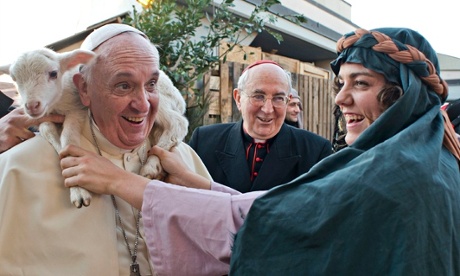
MDG Pope Francis with a lamb
Pope Francis says he wants a church in which the shepherds smell of the sheep. Photograph: Osservatore Romano/Reuters
Pope Francis has repeatedly said he wants a poor church of the poor. At a time when millions of people are experiencing the impact of brutal economic policies and unbridled corporate greed, he has attracted admiration from Catholics and non-Catholics for his condemnation of the economic system and the simplicity of his own life.

He has also acknowledged the need to give women a greater say in the life of the church, though he has done little to achieve this. Yet poverty impacts unrelentingly and acutely on women’s lives, and nowhere does the absence of women’s influence manifest itself so clearly as around the church’s teachings on sexual and reproductive ethics.

While papal encyclicals abound with negative references to contraception and abortion and positive references to motherhood, marriage and the family, one can search in vain for any discussion of maternal mortality. Like his predecessors, Pope Francis has a tendency towards romanticism when speaking about motherhood. This is a dangerous fantasy when it occludes the harsh realities and struggles of women’s reproductive lives.

If the pope wants a church that prioritises the needs of the poor, then addressing women’s reproductive wellbeing is fundamental to that goal. Maternal mortality is often a direct consequence of poverty. Of an estimated 280,000 maternal deaths a year, 99% occur in the world’s poorest countries – mostly in sub-Saharan Africa and south Asia. Good obstetric care would prevent most of these deaths, but issues of contraception and abortion raise more contested ethical issues.

I do not defend the Catholic church’s position on contraception. However, it is important to separate women’s reproductive rights from contraceptive programmes linked to population control policies. Feminists speaking for the global south, such as Kalpana Wilson, argue that these are driven by exploitative economic policies and are often deeply coercive. Paradoxically, when working documents for the 1994 International Conference on Population and Development in Cairo included a heavy emphasis on population control, the Catholic church and the international women’s movement, though deeply hostile to each other, campaigned effectively to refocus the international development agenda away from population control to women’s education and empowerment.

Recent research shows that the most effective way of reducing birth rates is through female education, which also has a significant impact on reducing infant mortality. An educated woman who knows that her children are likely to survive will have fewer children than women in areas with high infant mortality rates and poor access to education. It is also interesting to watch Hans Rosling’s TED talk, in which he shows that birth rates stabilise or decrease when poverty is reduced, irrespective of religious influences.

None of this is to deny that access to safe, reliable and affordable contraception is important if women are to exercise reproductive choices. However, while a change in the church’s teaching on contraception may be long overdue, this must not translate into an uncritical endorsement of contraceptive programmes inflicted on the world’s poor. Rather, the international community must focus on poverty alleviation and the education and empowerment of women and girls, not only because justice demands it but because it has been shown to be the most effective way of tackling the population crisis.

The abortion issue has similar implications, though most Catholics I know regard this as a more complex ethical issue than contraception. I know few who would agree that it is simply a question of individual autonomy and a woman’s right to choose, though that does not mean they support criminalising abortion. The church says abortion is always wrong; feminists say it is always a right, but in the real world we sometimes face complex moral dilemmas where rights and wrongs are not so easily distinguished.

The polemical nature of the debate means that statistics – which are already unreliable – are manipulated by both sides. Opponents of abortion argue that access to abortion does not reduce maternal deaths, pointing to the fact that countries such as Chile and Ireland have very low maternal mortality rates despite abortion being illegal. However, such claims ignore the fact that 40,000 women die every year because they would rather risk an unsafe abortion than carry an unwanted pregnancy to term. While early pregnancy might rarely be a direct cause of maternal death, unsafe abortion most certainly is. These issues must be acknowledged in any debate about the Catholic church and women’s reproductive and sexual rights, particularly with regards to poverty and motherhood.

At a grassroots level, Catholic agencies and religious orders are major providers of education and healthcare to the world’s poor. This includes providing antenatal and obstetric care, dealing with the consequences of botched abortions, and caring for people living with HIV and Aids. However, some of this work goes on under the radar. Catholic healthcare providers are often afraid to publicise some aspects of their work – such as post-abortion care or supplying condoms to those at risk of HIV and Aids – in case their funding is cut off or they are censured by their bishops.

If he is serious about wanting a poor church of the poor, the pope has to create a safe space in which these issues can be discussed. He has said that he prefers “a church which is bruised, hurting and dirty because it has been out on the streets, rather than a church which is unhealthy from being confined and from clinging to its own security”. He has emphasised the maternal character of the church, and he says he wants a church in which the shepherds smell of the sheep. How about a maternal church in which the shepherds smell of bruised, hurting and dirty women dying in childbirth?

Thursday, 10 October 2013

The Holy See, the United Nations and Women's Rights


'Theology that hears the poor'

This is the text of an article by me published in this week's Tablet. Scroll down to see the published version, but as it's awkward to navigate I'm posting the text here as well.

--> If you are interested in reading more about the issues covered in this article, I highly recommend Half the Sky: How to Change the World by Nicholas D. Kristof and Sheryl Wudunn. You might also appreciate Margaret Atwood's poem, Christmas Carols.


Pope Francis claims that the Church lacks ‘a deep theology of woman’. This is only partially true. Since Vatican II, Catholic women theologians from all continents have been reflecting on women’s lives in the spirit of the Council, but these theologies have yet to find official acceptance. On the other hand, ‘theology of the body’, inspired by Pope John Paul II’s catechesis on the Book of Genesis and his 1988 apostolic letter on women, Mulieris Dignitatem, now forms the basis for all the Church’s official teachings on women and sexuality, as can be seen from the website of the Women’s Section of the Pontifical Council for the Laity.

This year sees the twenty fifth anniversary of Mulieris Dignitatem, and the Women’s Section is organising a symposium to mark the event. The report on the last such symposium, held in 2008, suggests that the participants were selected on the basis of their support for theology of the body and their condemnation of feminism and gender theory. There has been little attempt by the Women’s Section to engage with women theologians who might offer a different perspective.

John Paul II’s teachings on the goodness of the body and the positive significance of married sex were in many ways a transformation in Catholic theology. He also arguably did more than any other Pope to promote women’s rights within the parameters of Catholic teaching. Nevertheless, his understanding of motherhood and femininity was highly romanticised, as was his theology of marriage, based on the principle of sexual complementarity between male and female. This has provided theological inspiration for some heterosexual couples who, by luck, judgement or circumstance marry the right person, find satisfaction in traditional gender roles and are able to practise natural family planning, but theology of the body has little to offer to those whose experience of marriage is wounded by divorce or blighted by violence, abuse or poverty. Theology of the body is also hostile to homosexuality.

As the United Nations and international NGOs have become increasingly focused on issues of gender, sexuality and women’s rights, theology of the body has been promoted by the Vatican as a form of resistance to feminism and gender theory, and to the perceived threat posed by contraception, abortion and homosexuality to marriage and the family. Yet in its romantic sexual stereotypes, in its tendency to misrepresent or silence the voices of those with whom it disagrees, and in its glossing over of complex ethical issues to do with sexuality, reproduction and motherhood, theology of the body is in many ways an obstacle in the way of developing the ‘deep theology of woman’ that Pope Francis invites.

If Catholics are to respond to Francis’s call to become a Church of the poor, then the challenges posed by questions of women’s rights, maternal well-being, reproductive choice and the scandal of maternal and infant mortality have to be addressed by those most qualified to speak with and for poor women. Pope Benedict XVI’s 2009 social justice encyclical, Caritas in Veritate, makes no mention of maternal mortality or HIV/AIDS, despite the fact that an estimated 800 of the world’s poorest women die every day through causes relating to pregnancy and childbirth. By contrast, a pastoral letter on the Millennium Development Goals published in June 2013 by the Bishops of Uganda and addressed to that country’s Government dedicates significant space to HIV/AIDS and to questions of justice for women and combatting maternal mortality. Perhaps this is a symptom of how a change in papal style is creating space for different voices to be heard within the Catholic hierarchy.

Next year is Cairo +20 – the twentieth anniversary of the 1994 UN Cairo Conference on Population and Development. This might be the first real test of Francis’s determination to bring about a shift in emphasis, from a Church obsessed with questions of contraception, abortion and homosexuality, to a Church whose identity and mission comes from living the Gospel in radical solidarity with the poor.

The 1994 Cairo Conference was regarded as a diplomatic disaster for the Vatican. The Holy See aligned itself with some Islamic states in opposing resolutions which included terms such as ‘reproductive rights’ and ‘sexual health’, because it perceived these as attempts to promote abortion and population control policies and to undermine marriage and the family. More recently, in March 2013, the Holy See once again attracted widespread condemnation for joining with Russia, Egypt and Iran to oppose a UN declaration against gender violence because it included reference to sexual, reproductive and gay rights.  

Such reports fuel hostility towards the Catholic Church, some of which is based more on prejudice than on informed debate. In an effort to avoid a repeat of the 1994 fiasco, John Paul II went to considerable lengths to ensure that the Vatican was well-represented at the UN Beijing Conference on Women in 1995, with a delegation led by the then Harvard law professor Mary Ann Glendon. Reporting in The Tablet afterwards, Annabel Miller wrote that the Holy See’s delegates ‘had been chosen not only for their loyalty to the Church, but for their intellectual – and street – credibility’, but she goes on to say that ‘this was not enough to break through the wall of prejudice, even hatred, among some secular feminists’. So there is a need for bridge-building on both sides.

The Vatican is already a significant voice for the poor around issues such as migration and refugees, economic exploitation, human trafficking and war and conflict, and the Catholic Church is a leading provider of female education through its religious orders. However, its credibility will continue to be undermined unless it also engages in more constructive dialogue within the UN and other agencies about maternal mortality, reproductive health, gender-based violence and women’s rights. This includes ensuring that the poor are defended against population control policies directed more at protecting the interests of the rich than the rights of the poor. There is also evidence that female education is more effective in reducing family sizes than campaigns focusing exclusively on contraception, and the Vatican is right to point this out. Yet educated women are able to limit the number of children they have because they can make informed choices about pregnancy, and that requires access to reliable contraception. If the Church’s opposition to abortion is to be seen as a genuine concern for the rights of the unborn and not as simply another attempt to deny women’s rights, and if it is to have credibility in its interventions on the stage of international politics, then the benefits of contraception must be recognized, as must campaigns for gender justice and sexual equality.

Catholic health care providers are often in the forefront of dealing with the realities of these issues, beyond the ideological to-ing and fro-ing between the Holy See and the UN. For example, research currently being undertaken by Dr. Jill Olivier and others at the University of Capetown shows that, in some African countries, post-abortion care makes increasingly heavy demands on Catholic clinics and hospitals. Women and girls who experience heavy bleeding after inducing abortions at home go to Catholic facilities because they know they will not be turned away. For many, help comes too late. Accurate statistics are impossible to come by, but an estimated 68,000 women die every year as a result of unregulated abortion. A woman who would rather risk death than face an unwanted pregnancy is in despair.  Often these are young girls who have been victims of abuse or rape, and sometimes they face rejection by their communities. A Catholic agency I know of in Zimbabwe has set up a home for such girls, and tries to reconcile them with their families when their babies are born.

Such Catholic initiatives constitute the Church of the poor, providing an active daily response to Pope Francis’s call for the Church to be ‘a field hospital’ which responds to the call to ‘Heal the wounds, heal the wounds … And you have to start from the ground up’. Yet there is a blanket of secrecy thrown over some aspects of this work when it concerns reproductive health or providing condoms for people at risk of HIV/AIDS, because of the need not to be seen to contravene official Church teaching. Catholics working in such contexts are usually reluctant to go on the record, because of the well-founded fear that they will be condemned by their bishops and their funding will be withdrawn.

Starting from the ground up means allowing theology to grow out of the grass roots experience of those who put human suffering before moral absolutes. There is far more to women’s theology than questions of reproduction and motherhood, just as there is far more to the Church’s work among the poor than crisis intervention. Yet if a deep theology of woman cannot provide a compassionate response to those women who suffer most acutely because of sexual violence, poverty and the lack of adequate reproductive health care, then it is failing to hear the cry of the poor.

A deep theology of woman must be a theology by and for women, which learns from women’s visions and struggles in terms of justice and ethics, sexuality and motherhood, sacramentality and prayer. There are many who would welcome an opportunity to discuss these issues more openly within the Church. The Women’s Section of the Pontifical Council for the Laity would be an ideal forum for such discussions. In this age of reform, might we yet see such a space opening up? This would allow the official Church to engage with the resources it needs to develop that deep theology of woman which Francis says it currently lacks.


Friday, 15 March 2013

Pope Francis and the Poetry of Hope


A seagull sits on the chimney on the roof of the Sistine Chapel while another flies overhead in St. Peter's Square during the second day of the conclave to elect a new pope at the Vatican on Wednesday.To be hopeful, to embrace one possibility after another - that is surely the basic instinct. Baser even than hate, the thing with teeth, which can be stilled with a tone of voice or stunned by beauty. If the whole world of the living has to turn on the single point of remaining alive, that pointed endurance is the poetry of hope. The thing with feathers.
BARBARA KINGSOLVER, High Tide in Tucson


Hope and optimism are not at all the same thing. Indeed, optimism is perhaps the most cunning and deceptive counterfeit of hope. 

Optimism mortgages the present in the name of an always-deferred future. It ignores the ground beneath our feet, the wind in our faces and the starry sky above, because it is always scanning the horizon looking for signs of a brighter tomorrow. Optimism is the fuel that feeds the insatiable appetites of consumerism, for it is the voice that clamours inside us and tells us that things ought to be better than they are, we can make them better than they are, we deserve for them to be better than they are. An optimist can never truly delight in what is, for he or she is always distracted by the nagging question, 'Is this all there is?' Is this, in the title of a great film, 'as good as it gets'? 

Hope is the sustaining breath of life in the here and now. Without hope, maybe we wouldn't be at all. Maybe we would lack the will which connects one breath to the next, one moment to the next, one event to the next, knitting together our bodies and souls to make us creatures of poetry and imagination and music and meaning and yearning. 'Unless' is a word associated with optimism. 'Nevertheless' is a word associated with hope. Optimism grits its teeth, endures what is, and awaits what might be. Hope plunges into what is and turns its naked soul to the drenching of joy or the drowning of sorrow, knowing that only one who is fully alive can experience either.

These are my reflections during this week when, for the first time in many years, being a Catholic creates a sense of freshness and delight about the Church and its possibilities and promises. In the last few years, and particularly in the last couple of weeks, I've reflected a great deal on the difference between hope and optimism. As we awaited the announcement of the new Pope, I was not optimistic. Who would it be? I read the biographies of the papabili with a heavy heart. I feared that things could get worse, not better. 

But hope is not about waiting for things to get better. Hope is having the commitment and the determination to struggle on in that space where one feels called to truth,  that space of language and meaning and gesture which evokes some response in the depths of one's soul, however much debris gets in the way, however many distractions and disappointments clutter the pathways of hope. I have no doubt that God calls the human heart along many avenues of truth discerned in faithfully following different religions and philosophies, but I also believe that we have a certain responsibility to truth - to seek it, and to recognize that it is not an objective fact about the world but a way of being within the world. For me, that way of being is inseparable from the overgrown and tortuous path that began to unfold - moment by moment and in the smallest and most hesitant of steps - when I was received into the Catholic Church.

I believe that the Holy Spirit guides the Church. In my own life, I have struggled more than I can say to remain Catholic, and I have many, many questions and doubts. Nevertheless, I experience the Catholic Church as the sacramental community wherein I glimpse - obscurely, elusively and fleetingly - the incarnate divine life continuously materializing in the mystery of creation, in the fragility, beauty and endurance of human love, in the fidelity and tenderness of friendship, and in the sorrow and failure and loss that cast their shadows within us. There is a quotation by Nicholas Sparks, in his book The Last Song: “Love is fragile. And we're not always its best caretakers. We just muddle through and do the best we can. And hope this fragile thing survives against all odds.”(Nicholas Sparks, The Last Song) That sums up for me what the last few years have been like as a Catholic. 

Cynicism is the enemy of hope, but I have often been tempted by cynicism. Optimists go in search of something better and that too has been a real temptation. But when I think of doing that I remember what Groucho Marx said: 'I don't care to belong to any club that would have me as a member.' If I move elsewhere, I take with me my own baggage, my own unresolved issues, my own failings and meanness of spirit. If I magnify those faults a million times, I realize that I'll be in another church full of people like me, and therefore it will be a church or some other community that can't begin to be what I think it ought to be. 

This restlessness and dissatisfaction are not to be compared to the motives of those who leave because they can no longer bear the cruelty and suffering that has been inflicted upon them as Catholics - victims of abuse and neglect, victims of indifference, but also victims of harsh moral judgement and condemnation by those who refuse to accept the fragility, complexity and struggle of human sexuality as it seeks meaning within the body of Christ. Those people leave a tangible absence. Their leaving casts shadows which must not be covered over or denied. These are not meaningless absences, such as might be associated with people who were never present and are not missed. They are the dark and meaningful spaces which must remain empty because unique and irreplaceable human beings once occupied them, and they continue to inhabit those spaces as people who die contine to inhabit the lives of those who love them. No matter how many people join the Church, no matter how rapidly the Church is growing in certain parts of the world, a multitude of converts will never be enough to fill the infinite space left by even one individual who sought the love of Christ and encountered only abuse and condemnation. When God looks at the Catholic Church today, I sometimes wonder if the divine gaze rests upon those shadows of absence and names them one by one, for each one marks a crucifixion and an abandonment.

All this has to be held in trust. All this is the meaning of hope. I am not optimistic for Pope Francis, but I am delighted nonetheless. Hope doesn't have to be vindicated to be realized, for hope is realized in the very act of living. Hope can't be disappointed, but optimism can only be disappointed. Perhaps if it had been some other Pope, the delight would have been less but the hope would have had to become more intense, more closely focused and attentive in order to discern the shimmer of redemption working among us. We should beware an easy optimism which will only lead to disappointment. 

Yet there are moments when hope and delight coincide, when a watery sun rises through the mist to greet the coming day, and one realizes how cold it has been, how severe the winter was, how harsh the wind felt on the naked skin of hope. Every moment of every day is in itself a manifestation of hope, but how wonderful it is when hope glows warmly and shimmers with surprise and delight, as it does this week.


Pope Francis
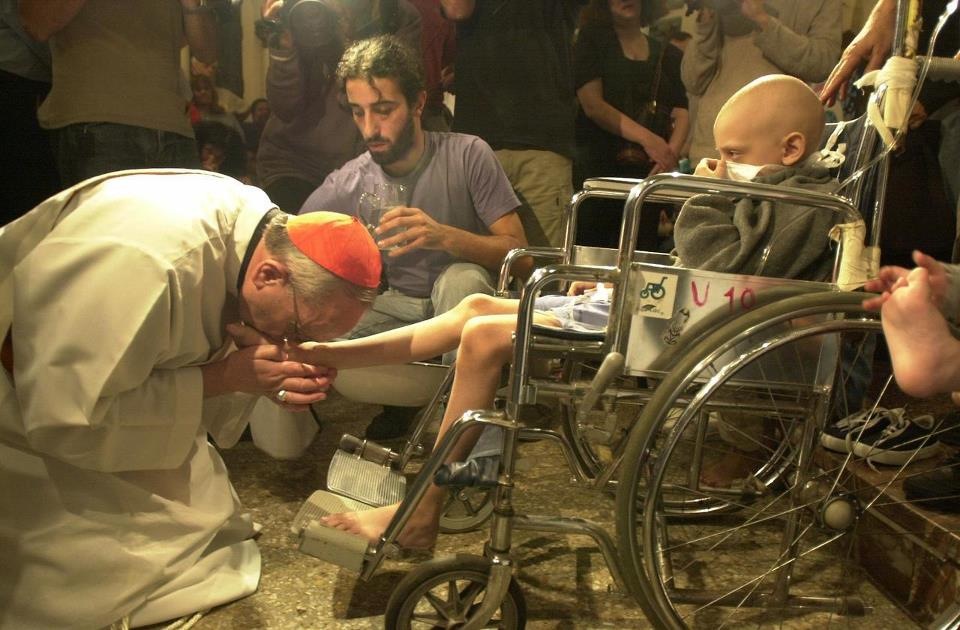
Pope Francis (Cardinal Bergoglio) visits an AIDS hospice in 2001