Showing posts with label maternal mortality. Show all posts

Wednesday, 27 August 2014

Pope Francis, Poverty and Women

Here is a piece I wrote for The Guardian's 'PovertyMatters' blog. I have cut and pasted the text here, but if followers of my blog would like to post comments or to contribute to the debate, may I suggest that you do so on The Guardian's comments page, in a way that respects the rules of reasoned engagement and courteous dialogue? Thank you.

Pope Francis has done little to improve women’s lives

Women do not seem to have a place in the pope’s vision of a Catholic church that cares for the world’s poor people
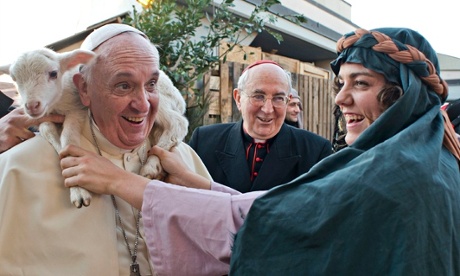
MDG Pope Francis with a lamb
Pope Francis says he wants a church in which the shepherds smell of the sheep. Photograph: Osservatore Romano/Reuters
Pope Francis has repeatedly said he wants a poor church of the poor. At a time when millions of people are experiencing the impact of brutal economic policies and unbridled corporate greed, he has attracted admiration from Catholics and non-Catholics for his condemnation of the economic system and the simplicity of his own life.

He has also acknowledged the need to give women a greater say in the life of the church, though he has done little to achieve this. Yet poverty impacts unrelentingly and acutely on women’s lives, and nowhere does the absence of women’s influence manifest itself so clearly as around the church’s teachings on sexual and reproductive ethics.

While papal encyclicals abound with negative references to contraception and abortion and positive references to motherhood, marriage and the family, one can search in vain for any discussion of maternal mortality. Like his predecessors, Pope Francis has a tendency towards romanticism when speaking about motherhood. This is a dangerous fantasy when it occludes the harsh realities and struggles of women’s reproductive lives.

If the pope wants a church that prioritises the needs of the poor, then addressing women’s reproductive wellbeing is fundamental to that goal. Maternal mortality is often a direct consequence of poverty. Of an estimated 280,000 maternal deaths a year, 99% occur in the world’s poorest countries – mostly in sub-Saharan Africa and south Asia. Good obstetric care would prevent most of these deaths, but issues of contraception and abortion raise more contested ethical issues.

I do not defend the Catholic church’s position on contraception. However, it is important to separate women’s reproductive rights from contraceptive programmes linked to population control policies. Feminists speaking for the global south, such as Kalpana Wilson, argue that these are driven by exploitative economic policies and are often deeply coercive. Paradoxically, when working documents for the 1994 International Conference on Population and Development in Cairo included a heavy emphasis on population control, the Catholic church and the international women’s movement, though deeply hostile to each other, campaigned effectively to refocus the international development agenda away from population control to women’s education and empowerment.

Recent research shows that the most effective way of reducing birth rates is through female education, which also has a significant impact on reducing infant mortality. An educated woman who knows that her children are likely to survive will have fewer children than women in areas with high infant mortality rates and poor access to education. It is also interesting to watch Hans Rosling’s TED talk, in which he shows that birth rates stabilise or decrease when poverty is reduced, irrespective of religious influences.

None of this is to deny that access to safe, reliable and affordable contraception is important if women are to exercise reproductive choices. However, while a change in the church’s teaching on contraception may be long overdue, this must not translate into an uncritical endorsement of contraceptive programmes inflicted on the world’s poor. Rather, the international community must focus on poverty alleviation and the education and empowerment of women and girls, not only because justice demands it but because it has been shown to be the most effective way of tackling the population crisis.

The abortion issue has similar implications, though most Catholics I know regard this as a more complex ethical issue than contraception. I know few who would agree that it is simply a question of individual autonomy and a woman’s right to choose, though that does not mean they support criminalising abortion. The church says abortion is always wrong; feminists say it is always a right, but in the real world we sometimes face complex moral dilemmas where rights and wrongs are not so easily distinguished.

The polemical nature of the debate means that statistics – which are already unreliable – are manipulated by both sides. Opponents of abortion argue that access to abortion does not reduce maternal deaths, pointing to the fact that countries such as Chile and Ireland have very low maternal mortality rates despite abortion being illegal. However, such claims ignore the fact that 40,000 women die every year because they would rather risk an unsafe abortion than carry an unwanted pregnancy to term. While early pregnancy might rarely be a direct cause of maternal death, unsafe abortion most certainly is. These issues must be acknowledged in any debate about the Catholic church and women’s reproductive and sexual rights, particularly with regards to poverty and motherhood.

At a grassroots level, Catholic agencies and religious orders are major providers of education and healthcare to the world’s poor. This includes providing antenatal and obstetric care, dealing with the consequences of botched abortions, and caring for people living with HIV and Aids. However, some of this work goes on under the radar. Catholic healthcare providers are often afraid to publicise some aspects of their work – such as post-abortion care or supplying condoms to those at risk of HIV and Aids – in case their funding is cut off or they are censured by their bishops.

If he is serious about wanting a poor church of the poor, the pope has to create a safe space in which these issues can be discussed. He has said that he prefers “a church which is bruised, hurting and dirty because it has been out on the streets, rather than a church which is unhealthy from being confined and from clinging to its own security”. He has emphasised the maternal character of the church, and he says he wants a church in which the shepherds smell of the sheep. How about a maternal church in which the shepherds smell of bruised, hurting and dirty women dying in childbirth?

Sunday, 20 June 2010

Maternal Mortality and Deepwater Horizon

Naomi Klein wrote a brilliant article in yesterday's Guardian: 'Gulf Oil Spill: a hole in the world'. Here's a taste of what she says, in an article which acknowledges its debt to Carolyn Merchant's 1980 book, The Death of Nature:

Thankfully, many are standing not in wonder at humanity's power to reshape nature, but at our powerlessness to cope with the fierce natural forces we unleash. There is something else too. It is the feeling that the hole at the bottom of the ocean is more than an engineering accident or a broken machine. It is a violent wound in a living organism; that it is part of us.
John Wathen, a conservationist with the Waterkeeper Alliance, was one of the few independent observers to fly over the spill in the early days of the disaster. After filming the thick red streaks of oil that the coast guard politely refers to as "rainbow sheen", he observed what many had felt: "The Gulf seems to be bleeding." This imagery comes up again and again in conversations and interviews. Monique Harden, an environmental rights lawyer in New Orleans, refuses to call the disaster an "oil spill" and instead says, "we are haemorrhaging". Others speak of the need to "make the bleeding stop". And I was personally struck, flying over the stretch of ocean where the Deepwater Horizon sank with the US Coast Guard, that the swirling shapes the oil made in the ocean waves looked remarkably like cave drawings: a feathery lung gasping for air, eyes staring upwards, a prehistoric bird. Messages from the deep.
And this is surely the strangest twist in the Gulf coast saga: it seems to be waking us up to the reality that the Earth never was a machine. After 400 years of being declared dead, and in the middle of so much death, the Earth is coming alive.
When I read that, I remembered what happened when I had a sudden haemorrhage late in my fourth pregnancy, and the strange feeling of helplessness as blood pumped from my body. I often reflect on the fact that, had I not been in a modern hospital equipped to perform an emergency caesarean, I would have lain there bleeding until my baby and I were both dead. Is that how Mother Earth feels right now, I wonder?

But there's an added twist. I was living in Zimbabwe, and my life was saved because I was a relatively rich expatriate who could afford to give birth in a private hospital. Although maternal mortality rates have improved significantly in the last decade, the most recent figures released by the World Health Organisation show that 343,000 women a year still die through causes related to pregnancy and childbirth, 99% of them in the world's poorest countries. Afghanistan is the most dangerous country in the world in which to give birth - a statistic which reflects shamefully on our military interventionists who after so many years of violent and incompetent meddling have done nothing to improve those women's lives. But apart from Afghanistan, it is African countries which cluster near the bottom. Zimbabwe is 164 out of 181.

So what's the connection with Deepwater Horizon? A few weeks ago, The Guardian carried a bleak report about environmental damage done by oil spills around the world as a result of the poor safety standards and exploitative policies of the major oil companies. In the Niger delta, the activities of the oil company Shell are estimated to have resulted in at least 2,000 sites requiring treatment because of oil pollution. Morever, 'Independent oil and environmental experts estimate that between 9m and 13m barrels of oil have been spilt in the delta area during the past 50 years – equivalent to an Exxon Valdez disaster every 12 months.'

In other words, 'Mother Earth' suffers in the same way that ordinary mothers suffer, in silent and ongoing anguish in the poorer countries where nobody knows and nobody cares, although her misery far outstrips the occasional well-publicised emergency in the richer countries. And yet rich mothers still sometimes die in childbirth, and sudden haemorrhage remains a significant cause of maternal mortality even in well-equipped hospitals. Sometimes, nature outstrips our best technology. That individual mothers sometimes die giving birth may be a fact of life, even if we smooth out every economic injustice and save many more than we do today. But if we destroy the maternal body upon which we all depend, if the Earth herself bleeds to death, what then? In this case, even as the people of the Gulf despair, perhaps the one small consolation is that this maternal crisis is happening in a country rich enough and powerful enough to take action.

It may be that it's not too late, but soon it will be. We have a placental relationship to the Earth, and if we poison that life-giving body or rip open its arteries, we too are doomed.

How long until a political leader emerges who is brave enough to acknowledge that it's not Britain that's broken - it's our very way of being human, and much of that has to do with our economic system and the capitalist ideology which underpins it. We are careering downhill on an ambulance that has lost its brakes, while the mechanics are fiddling with the dashboard trying to work out how to dim the lights.


Friday, 26 February 2010

Maternal mortality: the equivalent of three 747s crashing every day

I recently gave a public lecture at St. Thomas University in Fredericton, New Brunswick, titled 'Dialogue, difference and human development: gendered perspectives on Catholic social teaching'. Here's a taster. If you want to read the whole lecture, click here to go to my website to download the full text:

Part of Benedict XVI’s concern for privacy is to prevent state interference in the family through policies of population control such as enforced contraception and sterilisation. I think this is an important issue which is neglected by many feminist campaigns which confuse reproductive rights with population control. They are not the same, and policies of population control can involve extreme violations of women’s reproductive rights. Nevertheless, this brings me to the most problematic and I’m aware the most sensitive aspect of my questioning of Caritas in Veritate, and that is its implicit refusal to engage with the complex issues which arise if one takes seriously the mother-child relationship as an inseparable duality of persons which can sometimes give rise to tragic and insoluble moral conflicts. So, what happens if the human life that is weak or marginalised, devalued and violated by a society, is the life of a childbearing woman or, to be more precise, the 536,000 women who die every year as a result of complications and neglect during pregnancy and childbirth, and who merit not even a passing mention in a papal encyclical concerned with the ethics of life? As Canadian feminist theologian Eileen Kerwin Jones points out, ‘This loss of life is equivalent to that which would occur if three 747 planes crashed daily.’ She quotes a Canadian obstetrician who observes that, ‘From the time you had your morning coffee today until the same time tomorrow, 1,600 women will have died from complications of pregnancy.’ In addition, an estimated 50 million women are chronically disabled every year from pregnancy-related causes, and the vast majority of these dead and disabled women – 99% - are in the world’s poorer countries. As Kerwin Jones argues, ‘this statistic translates into the staggering fact that almost one in four of all adult women living in the poorer nations of our world are chronically disabled as a direct result of pregnancy and childbirth.’